Essay: 'Any Given Sunday' Is A Blitz To The Senses (1999)
Men shout at each other in Oliver Stone's football opera
Thank you, but I’d rather watch a movie about football than an actual football game. I’m not mocking the sport or its fans. But I prefer make-believe stories to the real world. In a movie, actors playing football players aren’t in danger of irreparable traumatic brain injuries.
Unfortunately, there aren’t that many good football movies. Baseball is the MVP when it comes to the sports genre. What a romantic sport. I just watched Eight Men Out for the first time, and Moneyball is one of my comfort movies—I stream it all the time. And Bull Durham? There just aren’t that many genuinely great pigskin flicks.
The classic little guy tearjerker Rudy is probably Best in Show. The 1974 version of The Longest Yard, starring Burt Reynolds, is a favorite, a two-for-one football and prison movie. The 2005 remake wasn’t that great. The 2004 film version of the Texas high school football drama Friday Night Lights is pretty good. The first season of the TV show is *chef’s kiss*.
Bruce Willis’ The Last Boy Scout is an underrated action movie that is football adjacent. And then there’s Any Given Sunday, a football movie that desperately wants to be important but has to settle for being exciting. Any Given Sunday isn’t art, but at least it isn’t boring.
Every so often, I’m in the mood for imperfect but not boring. I recommend Any Given Sunday instead of the big game or any game, but that’s just me.
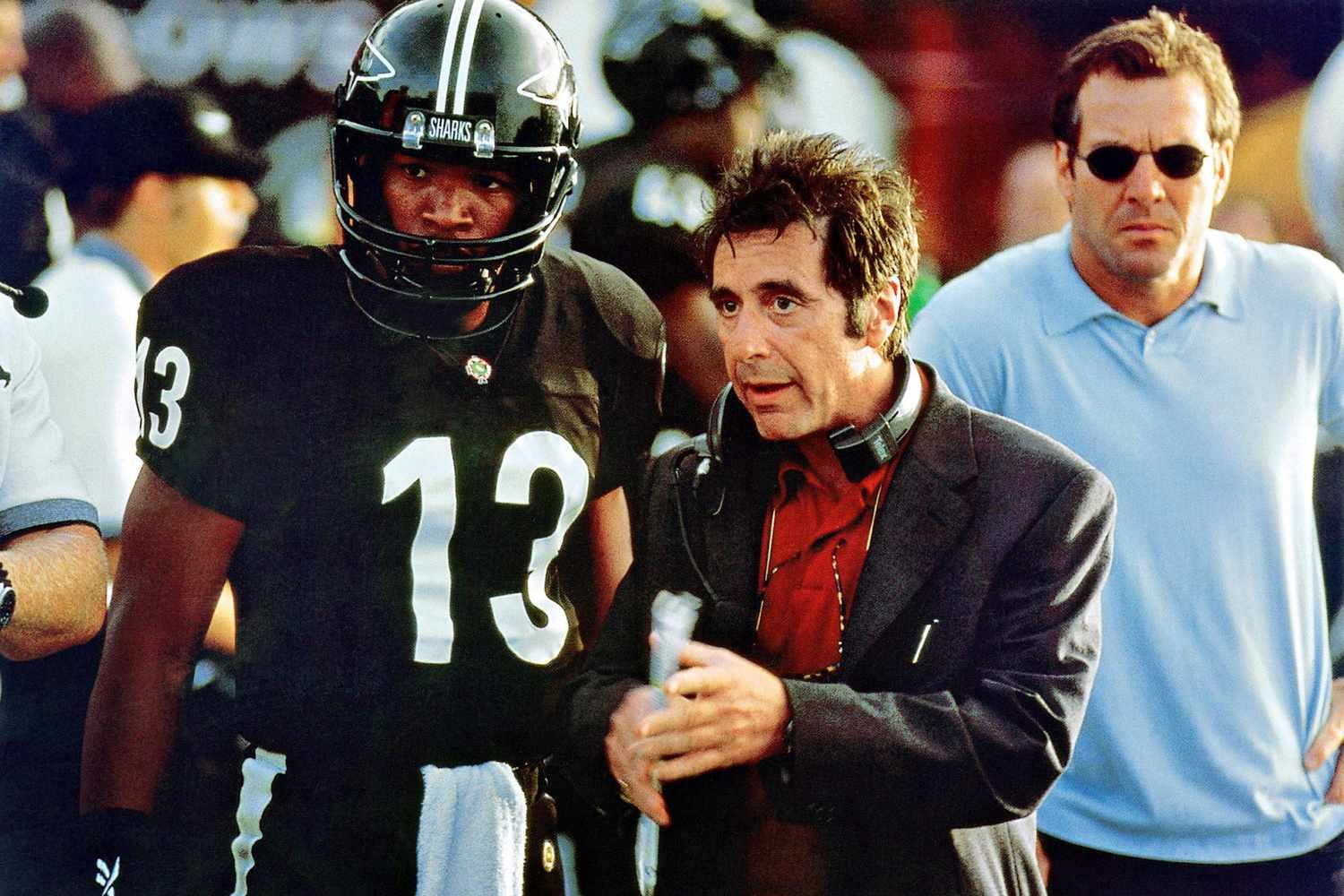
The movie is mostly men sweating, swearing, and suiting up for the big game. They crash into each other on and off the gridiron. The women are either sex workers or castrating wives (with one notable exception.) It stars Al Pacino at his sleepy-eyed middle-aged best as a grizzled veteran coach who loves football more than family and shouting more than talking.
Directed by Oliver Stone, Any Given Sunday is a shotgun blast of testosterone to the face. I grew a third testicle while rewatching it on Amazon Prime. It is a trashy, sexist, 21-year-old, two-hour-and-43-minute-long macho magnum opus about modern-day gladiators. I’m not drawing a comparison between football players and gladiators. No, no. Any Given Sunday connects those dots.
***
The basic plot is reminiscent of old Hollywood backstage classics like All About Eve— young divas versus old. The Miami Sharks are a struggling football team led by aging quarterback Dennis Quaid, and Jamie Foxx is an up-and-comer with his own ideas. When Quaid’s character gets injured, it’s time for Foxx’s upstart to become a star. That’s pretty much the story, with some Big Ideas about corporate politics and race in America and the loneliness of success thrown in a blender.
The cast is a who’s who of ‘90s character actors, from Aaron Eckhart to LL Cool J, and James Wood as a team Dr. Feelgood who puts wins ahead of the lives of the players, his patients. The movie is one of many reminders that the rabidly right-wing conservative was once a superb actor. Cameron Diaz shows up as a no-bullshit general manager navigating a man’s world. She is terrific, and the movie doesn’t deserve her.
The movie would be laughable if its primary message wasn’t so surprisingly savage, especially for a film made over twenty years ago. In Any Given Sunday, football is a human sacrifice. The players painted calves. It’s a game of bones, fracturing, and splintering to cheers. Football is violence.
The real drama of the movie is watching professional athletes trying to make as much money as they can before their bodies break down completely.
What the general public didn’t know then, even if it had been suspected, was that football-related concussions and other repetitive head injuries can cause memory loss, mood swings, cardiac arrest, and suicide. The NFL has denied the sport can result in brain damage but recent research has all but proved the risks these men take for the sake of entertainment.
This is a good resource for more information about the degenerative brain disease Chronic Traumatic Encephalopathy (CTE) which has been found in football players in shocking numbers.
I credit Any Given Sunday for being deeply critical of America’s favorite sport. This multi-billion dollar industry produces this country’s biggest secular holiday: the Super Bowl. But the movie is also madly in love with the sport. If Any Given Sunday is truly interesting, it’s because of that love/hate tension. Love wins in the end.
***
Any Given Sunday is also a time capsule from 1999, the last year of the American Century. It was a good time, especially if you were a man who loved the angry, misogynistic rap-rock of Kid Rock and Limp Biscuit. I don’t know why men were so angry back then because we had it pretty good, we could practically do anything and get away with it.
If you had told me then that the next twenty years would be full of war and poverty and plague, I would have turned up the volume on my Discman and rocked out to Korn’s ‘Freak on a Leash,’ a 1998 headbanger I definitely listened to in 1999.
I only bring this up because Any Given Sunday is wall-to-wall hip-hop, heavy metal, and, um, Moby with the volume turned up. The movie is vulgar and pretentious and almost self-aware, like the year it came out. It was directed by Oliver Stone, who obviously wanted to make a thinking man’s football movie, and he got close. Any Given Sunday is almost smart.
He’s asking the right questions but he never takes the time to answer them, preferring smash cuts to pulse-pounding, hyperkinetic music video montages of linebackers steaming towards each other head-on like living locomotives with death wishes. Stone’s cinematic football games are dramatic in ways that defy reality — rain, lightning bolts, guitars! It’s too much and then, suddenly, there’s more
If the movie has an anchor, it’s Pacino. And Any Given Sunday needed an anchor. He delivers a rousing locker room speech about life and football. Nobody does world-weary that Al. His chemistry with Foxx is tangible, too.
There is a scene between the two that takes place at the coach’s house. He’s invited his new QB over for dinner to discuss the future, and in the background, the sword-and-sandal epic Ben Hur is playing on the TV. I think the idea is Pacino was watching that cinematic spectacle about Ancient Rome while he was cooking and I get it, Mr. Stone, football players are gladiators. Yes, yes. The star of that movie, Charlton Heston, shows up in Any Given Sunday, by the way.
Even the racial politics in Every Given Sunday are from the 90s, which is to say, lacking clarity—this is a movie where a young, ambitious, talented Black man blindsides the rich white men in charge. But Stone doesn’t explore this dynamic. There is racial tension, but unlike the rest of the movie, it’s quiet. Understated.
I actually don’t know how to explain this movie without explaining Oliver Stone first. He doesn’t need explaining to film buffs or people who came of age in the 80s. Stone is a filmmaker with real cocaine energy who is responsible for two minor masterpieces about the Baby Boomer generation, the first being the gritty Vietnam War movie Platoon. The second? Wall Street, a smart drama about America’s addiction to money.
Stone’s movies examine the lie America tells itself. There was a time when he was probably the most high-profile conspiracy theorist in pop culture until we elected one President.
Platoon won the Best Picture Oscar, and Stone walked away with the trophy for director. It was an important movie at the time because Stone was a vet himself who fought in that war. Wall Street won the Best Actor Oscar for its star, Michael Douglas. Douglas’ famous monologue defending greed was immediately iconic. Stone’s other movies, including Born on the Fourth of July, Natural Born Killers, and JFK were all cultural events. He’s a uniquely visceral director who is especially good at capturing men in all their pain and triumph. He was, intentionally or not, an early chronicler of what some call “toxic masculinity” and others “guy stuff.”
If Any Given Sunday deserves to be revisited, it is because of that: it’s an electric Jackson Pollock portrait of men, loud and proud on the eve of the millennium. And I think it’s more entertaining than an actual game, but that’s just me.


Charlton Heston also starred in his own football movie, Number One, in which he is the aging veteran. Can you make a sports movie without an aging veteran?